Pungmul
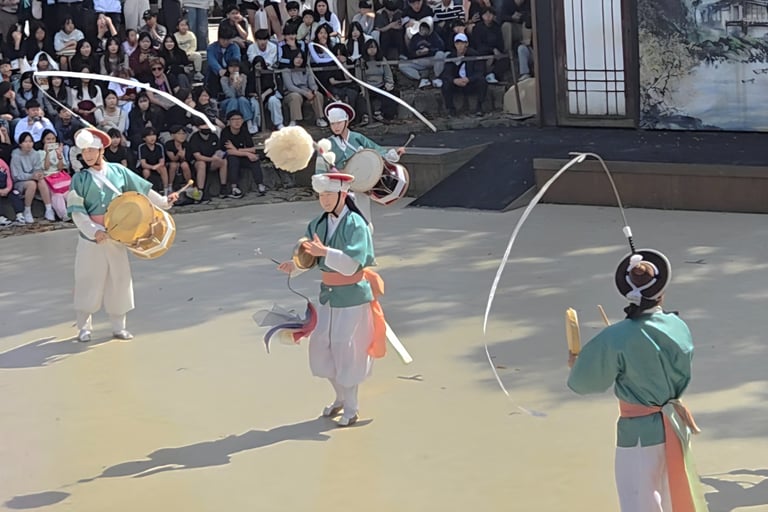
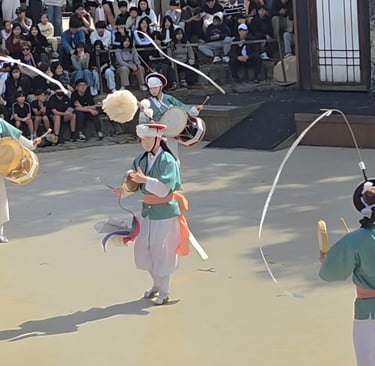
It is impossible to remain still when faced with pungmul. From the very first drumbeats, something awakens — the body, the breath, the attention. Pungmul is not music meant to be listened to from a distance. It moves forward, surrounds you, draws you in. It belongs to open spaces, to fields, villages and festivals. By nature, it is collective.
Before becoming a stage performance, pungmul was a music of everyday life, born in rural Korea. For centuries, it accompanied agricultural work, communal rituals, seasonal celebrations, moments of joy as well as times of tension. It was played to bring people together, to protect the community, and to celebrate life.
An ancient, popular and living art
Pungmul has its roots in Korea’s pre-modern farming society. It was performed during harvests, ceremonies to pray for a good agricultural year, or rituals meant to ward off evil spirits. At the time, it was often called nongak, literally “farmers’ music”.
But pungmul was never mere entertainment. It played a strong social role:
strengthening village solidarity
synchronising bodies during labour
channelling collective emotions
creating a space of freedom, sometimes even social critique
During the Japanese colonial period, these popular musical forms were marginalised and sometimes suppressed. Yet they survived, passed down orally in rural areas and communities. Today, pungmul is both cultural heritage and living practice, performed in universities, festivals, demonstrations and streets.
The instruments: the beating heart of pungmul
Pungmul relies mainly on percussion instruments, each with a distinct role and symbolic meaning. They are often referred to as the four instruments, or samul (사물), meaning “the four objects”.
Kkwaenggwari
A small handheld metal gong.
It acts as the leader of the ensemble. Its sound is sharp and piercing, used to give signals, mark transitions and command attention. The kkwaenggwari player leads the group, controlling the tempo and direction.
Janggu
The iconic hourglass-shaped drum of Korean music.
With two heads played differently, it offers great rhythmic variety. The janggu provides structure, dialogue and nuance, linking the other instruments together.
Buk
A large barrel drum with a deep sound.
It lays down the basic rhythm, steady and grounded. The buk is often associated with the earth and stability, its sound broad and enveloping.
Jing
A large suspended gong.
Its role is more ceremonial. It marks key moments and shifts in atmosphere. Its long, resonant tone adds depth and a sense of space, almost meditative amid the collective energy.
Together, these instruments create a complex rhythmic conversation, built on repetition, breaks and sudden accelerations. Pungmul is never static — it breathes.
Costume: colour, symbolism and movement
Pungmul is also a visual art. Performers wear a traditional white outfit, often referred to as work hanbok, symbolising purity and the simplicity of rural life.
This white base is complemented by:
colourful sashes or vests
red, blue and yellow ribbons, traditional colours linked to the elements and directions
sometimes decorated waistcoats or scarves
These colours are deeply symbolic, evoking balance in nature, yin and yang, and the fundamental elements.
The hat
No discussion of pungmul would be complete without mentioning its iconic hats, which give performances their hypnotic quality.
Sangmo
The most spectacular of all.
This hat is topped with a long white ribbon. By rotating the head, the performer sends the ribbon into circles, spirals and intricate shapes in the air. It requires exceptional control, balance and skill.
The sangmo symbolises:
the wind
movement
vital energy
Decorated hats
Other performers wear simpler hats, sometimes adorned with pom-poms or feathers, depending on regional styles.
In pungmul, the hat is never mere decoration — it extends the body’s movement, amplifies gestures and turns music into dance.
Music, dance and theatre combined (https://www.youtube.com/watch?v=5r1xOa9E8vg)
Pungmul is not only played — it is danced, embodied, and at times even theatrical. Performers move in formation, change positions and interact directly with the audience. Smiles, shouts and eye contact are all part of the performance.
In some traditional forms, pungmul includes:
humorous scenes
improvisation
direct interaction with spectators
It deliberately blurs the line between performers and audience.
From village paths to contemporary stages
Today, pungmul continues to evolve. It gave rise to samulnori, a more formalised stage-based genre developed in the 1970s. Yet pungmul itself remains closely tied to outdoor spaces, movement and the street.
It can be found:
at traditional festivals
in universities
during social and political demonstrations
in contemporary creations combining music, dance and theatre
It remains a form of joyful resistance, a way of saying: we are here, together.
Pungmul speaks to the body before it speaks to the mind. It reminds us of something essential: rhythm is collective. You do not play pungmul alone. You listen to others, adapt, and move forward together.
In a fragmented world, pungmul remains an invitation to form a circle, to share energy, and to reconnect with the earth and with one another.
And perhaps that is why, from the fields of the past to today’s stages, its rhythm continues to resonate.
Au village folk de Yongin
Pungmul, the rhythm of the land and the people